


 AUDI
AUDI
 BMW
BMW
 CADILLAC
 CHEVROLET
 CITROEN
 DACIA
DACIA
 DAEWOO
 DAIHATSU
 DODGE
DODGE
 FIAT
FIAT
 FORD
FORD
 HONDA
HONDA
 HYUNDAI
 ISUZU
ISUZU
 JEEP
JEEP
 KIA
KIA
 LAND ROVER
 MAXUS
MAXUS
 MAZDA
MAZDA
 MERCEDES
 MINI
MINI
 MITSUBISHI
 NISSAN
 PEUGEOT
 PORSCHE
 RAM
RAM
 RANGE ROVER
 RENAULT
 SEAT
SEAT
 SKODA
SKODA
 SSANGYONG
 SUBARU
 SUZUKI
 TOYOTA
 VAUXHALL
 VOLVO
VOLVO
 VW VOLKSWAGEN


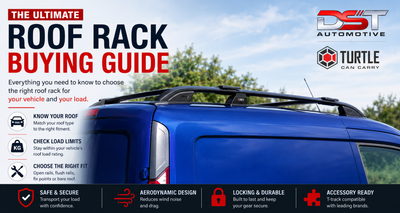
BUYING GUIDE — How to Choose a Roof Rack
DST Automotive on 11th May 2026
The Ultimate Roof Rack Buying Guide
Choosing the right roof rack is about more than simply finding something that fits your vehicle. The correct setup gives you a safe and practical way to carry ladders, pipes, timber, bikes, roof boxes, and other bulky equipment without overloading the interior of your vehicle.
Get it wrong and you can end up with compatibility problems, unnecessary wind noise, reduced load security, or even unsafe installation. According to London Connected, while 31% of UK drivers own a cycle rack or roof box, 58% are unaware they could risk fines or penalties if these systems are installed incorrectly.
This guide explains how to choose the right roof rack for your vehicle, how roof rack fitment works, what load ratings actually mean, and which setups are best for popular vans including the VW Transporter and Ford Transit.
Why your roof rack choice matters
A properly matched roof rack gives you a secure way to transport long or awkward loads while keeping interior space free. This matters for both commercial vans and family vehicles.
The right roof rack depends on three things: your roof type, your load requirements, and the fitting system your vehicle needs. Once you understand those three areas, choosing the correct product becomes much simpler.
Step 1: Know what is on your roof
Before buying anything, check what type of roof your vehicle already has. Roof racks are not universal, and different roof types require different fitting systems.
| Roof Type | What It Looks Like | What You Need |
|---|---|---|
| Raised / Open Rails | Rails sit above the roof with a visible gap underneath | Crossbars designed for raised or open rails |
| Flush / Closed Rails | Rails sit flush against the roof surface | Flush rail crossbars |
| Fix Points | Small anchor holes hidden beneath caps in the roof | Fix point roof rack kit |
| Bare Roof | No rails or visible anchor points | Clamp-fit or gutter-mount system |
If you are unsure what type you have, look along the side of the roof. Open rails have a visible gap underneath them, while flush rails sit tightly against the roofline. Vehicles with fix points usually have small plastic covers hiding threaded mounting points.
Step 2: Work out your load requirements
Every vehicle has a manufacturer roof load limit. This is the maximum weight your roof can safely support while driving. The roof rack itself also has its own load rating.
You must stay within both limits.
| Load Rating | Best For |
|---|---|
| 50kg | Roof boxes, bikes, smaller ladders, and lighter leisure equipment |
| 75kg | Trade loads such as timber, pipe bundles, ladders, and heavier equipment |
Most cars typically support between 50kg and 75kg. Commercial vans often support between 50kg and 100kg depending on the model. Always check your handbook before loading your roof rack.
Step 3: Choose the correct fitting type
Once you know your roof type and load requirements, you can match your vehicle to the correct rack system.
Crossbars for open or raised rails
These attach directly to raised roof rails with a visible gap beneath them. They are common on vans like the VW Transporter T5 and T6 as well as many SUVs.
Turtle crossbars feature aerodynamic oval bars to reduce wind noise, integrated locking systems, and T-track compatibility for accessories including bike carriers and roof boxes.
Crossbars for flush rails
Flush rail systems are designed for vehicles where the roof rails sit tight against the roofline. These setups usually give a lower-profile and more factory-style appearance.
Fix point roof rack kits
Vehicles without rails may still have factory mounting points hidden beneath plastic caps. Fix point kits bolt directly into these anchor points without drilling and are commonly used on commercial vans.
Top roof rack picks by vehicle
| Vehicle | Rail Type | Notes |
|---|---|---|
| VW Transporter T5 / T6 | Open rails or fix point | SWB and LWB fitments available |
| VW Transporter T6.1 | Open rails or fix point | Dedicated fitments by year |
| Ford Transit | Open rails | Available across multiple generations |
| Ford Transit Custom | Open rails | Fitments for 2012 onwards |
| Mercedes-Benz Sprinter | Open rails | Multiple generations available |
| Cars & SUVs | Flush or open rails | Wide range of fitments available |
What to check before you buy
Many compatibility issues happen because buyers miss simple checks during the ordering process. AUTODOC research reported that 71% of online auto part returns happen because of compatibility issues.
- ►Check whether your vehicle has open rails, flush rails, fix points, or a bare roof.
- ►Confirm your vehicle wheelbase if you drive a van, especially SWB or LWB.
- ►Choose a load rating suitable for your equipment and your vehicle roof limit.
- ►Check whether locking bars are included if you plan to leave the rack fitted overnight.
- ►Confirm all fitting hardware and instructions are included.
Ready to find the right roof rack?
The best roof rack for your vehicle depends on getting three things right: roof type, load requirements, and fitment. Once those are matched correctly, installation becomes straightforward and your rack performs the way it should.
DST Automotive stocks Turtle roof racks and roof rails for a wide range of vans, cars, and SUVs, including SWB and LWB fitments for many commercial vehicles.
Frequently Asked Questions
Are roof racks universal?
No. Roof racks depend on your roof type. Vehicles with open rails, flush rails, fix points, or bare roofs all require different fitting systems.
Can I fit a roof rack to a vehicle without rails?
Yes. Many vehicles have hidden factory fix points beneath plastic covers in the roof panel. Fix point roof rack kits attach directly to these anchors.
How will a roof rack affect my vehicle?
Roof racks can increase wind noise slightly and may reduce fuel economy when loaded due to added drag. Your vehicle height will also increase once the rack is fitted.
Do roof racks come with fitting hardware?
Yes. Turtle roof rack systems supplied by DST Automotive include fitting hardware, keys, and instructions.