



Tom McMahon on 20th Jul 2026
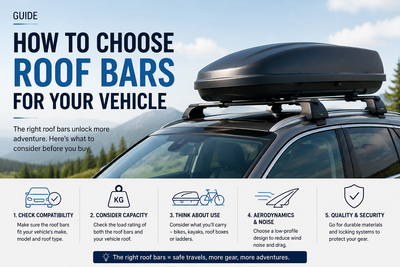
How to Choose Roof Bars for Your Vehicle
Roof bars are the crossbars that sit across your vehicle’s roof rails and carry your load. Get the wrong ones and they won’t fit, won’t lock, or won’t handle what you put on them.
This guide covers the four things you need to check before ordering: rail type, load rating, bar width, and fitment.
Roof Bars vs Roof Racks - What’s the Difference?
Roof bars and roof racks are related but not the same thing, and it’s worth being clear on the difference before you buy.
Roof bars, also called crossbars, are the two horizontal bars that span your vehicle’s roof from side to side. They attach to your existing rails or factory fix points and are the foundation for carrying anything on your roof. On their own, roof bars give you a mounting platform for accessories like roof boxes, bike carriers, kayak mounts, ski racks, and ladder clamps.
On the other hand, a roof rack is a full-frame structure that sits above the roofline and provides a larger, more rigid load platform. A rack usually includes its own mounting feet or legs that attach to the vehicle, and it replaces the need for standalone crossbars.
The practical difference comes down to what you’re carrying and how often. If you’re not sure which you need, the simpler starting point is roof bars. You can always add a load basket or full rack frame on top of crossbars later if your requirements change.
Step 1 - Match Your Crossbar to Your Roof Setup
The crossbar foot is what connects the bar to your vehicle, and the foot design is dictated entirely by your roof setup. There are three common configurations, each requiring a different foot type. Getting this wrong is the most common reason bars don’t fit.
There are three main roof setups:
- Open or raised rails are the most common setup on SUVs, estates, and commercial vans. The rail sits proud of the roofline with a visible gap underneath. If you can slide your fingers beneath the rail, this is your setup.
- Closed or flush rails sit flat against the roof surface with no gap. They follow the roofline rather than rising above it. This is common on cars with integrated OEM rails. If the rail and roof surface appear to meet flush, this is your setup.
- Fix points are factory anchor holes built into the roof panel with no visible rail at all, just small plastic-capped holes, usually near the door frame. A fix point kit bolts directly to these anchor points.
Raised rail roofs, which are the most common setup on SUVs, accounted for the largest share of the automotive roof rack market in 2025, valued at USD 830 million globally. Source: Bekryl Global Strategic Industry Review 2026
Each needs a different type of crossbar foot or mounting kit. If you want the full breakdown of roof types with a detailed identification guide, see our Ultimate Roof Rack Buying Guide.
Step 2 - Confirm the Load Rating You Need
To confirm the load rating for your roof bars, start by checking the manufacturer’s documentation. You can also have a look at the website you bought the product from, or the roof bars themselves, for a stamped rating. Every set of roof bars has a maximum load rating. Match this to what you’ll actually be carrying.
| Load Rating | Suitable For |
|---|---|
| 50kg | Lighter leisure loads like roof boxes, short pipes, or a bike carrier |
| 75kg | Standard trade loads, including ladders and shorter timber runs |
| 100kg+ | Heavy-duty commercial use - long runs, dense materials, multi-item loads, situations where loading to capacity |
Remember that your vehicle’s limit and the bar’s rated capacity are separate figures, and you must stay within whichever is lower. The dynamic load rating is the figure that matters most for everyday use, as it refers to the weight the bars can carry while moving.
For example, even if your roof bars are rated for 90kg, but your car roof is only rated for 65kg, your total limit is 65kg.
Step 3 - Choose the Correct Bar Width
Your roof bar width needs to match your vehicle’s roof width. Bars that are too narrow won’t span the load correctly, while bars that are too wide create unnecessary drag and may not sit or lock properly.
Most commercial vans take bars between 120cm and 145cm wide. SWB and LWB versions of the same van can require different widths, so check the product specification carefully before ordering. Vehicle-specific kits take the guesswork out of this, as the bar and the mounting feet are matched to your exact make, model, and wheelbase as a single fitment.
Step 4 - Confirm the Fitment for Your Specific Vehicle
Roof bar fitment is vehicle-specific. Even two SUVs with the same exact rail type can require different crossbar feet, spacing, and bar width. Always confirm the exact fitment for your make, model, year, and wheelbase before ordering.
DST Automotive stocks crossbars for a wide variety of cars, SUVs, and pickups. Below are some common vehicles, their rail types, and relevant notes about each fitment.
| Vehicle | Rail Type | Notes |
|---|---|---|
| Audi Q3, Q5, Q7 | Open / raised rails or flush rails | Multiple generations listed under both open and flush rail categories. Use the vehicle selector to filter by model and year. |
| BMW X3, X4 | Open / raised rails | Fitments listed under open rail crossbars. Confirm your year via the vehicle selector. |
| Ford Kuga / EcoSport | Open / raised rails | Both are listed under open rail crossbars. Check your year and rail type before ordering. |
| Ford Ranger | Open / raised rails | Pickup fitment listed. Confirm year and rail type via the vehicle selector. |
| Hyundai Tucson / Santa Fe | Open / raised rails | Both models listed. Use the vehicle selector to confirm the right crossbar for your year. |
| Kia Sportage / Sorento | Open / raised rails | Fitments listed for multiple generations. Confirm your year before ordering. |
| Land Rover Discovery / Discovery Sport / Freelander | Open / raised rails | All three models listed. Check your specific generation via the vehicle selector. |
| SEAT Leon ST | Flush / closed rails | Turtle AIR 2 crossbars confirmed. Rated to 75kg across both bars. Fits closed rail setup. |
| Ford Transit Custom (trade use) | Fix points | DST Professional heavy-duty bars available. Rated to 50kg per bar. Fit to factory mounting points, no drilling required. |
Use the vehicle selector on the DST Automotive roof racks page to confirm the exact bar for your van’s make, model, year, and wheelbase. If you’re unsure about your rail type or wheelbase, contact the team before ordering.
Roof Bar-Specific Checks Before You Order
Once you’ve confirmed your rail type and fitment, here are the other factors worth checking before you add anything to your basket:
- Bar profile: Consider your bar profile. You might want oval or aerodynamic bars, which are quieter at speed and compatible with the widest range of T-track accessories. Or if you have a heavier trade setup with specific accessory systems, square bars might be more your speed.
- Bar width: Double-check the specification of your roof bars to ensure the bar spans your roof correctly.
- T-track compatibility: If you plan to add bike carriers, roof boxes, or load clamps, confirm the bar has an integrated T-track channel so no adapters are needed.
- Wheelbase: SWB and LWB bars are not interchangeable, so make sure that you know your wheelbase prior to making a final decision.
- Load rating: Be sure to match your roof bars of choice to your heaviest load and confirm it sits within your vehicle manufacturer’s roof limit.
Did You Know?
The fuel consumption penalty from roof racks can range from 0 to 25% on passenger cars, depending on configuration, and the aerodynamic efficiency of roof racks can be greatly improved to reduce that individual vehicle fuel consumption impact. Source: Berkeley Lab News Center
Ready to Order Your Roof Bars?
DST Automotive stocks Turtle roof bars and crossbar kits for a wide range of vans, cars, and pickups. Use the vehicle selector at dstonline.co.uk to find confirmed fitments for your exact make, model, and year. If you have any questions about compatibility or rail type, the team is available via WhatsApp or the support request form.
Shop all roof racks →
Shop roof rack accessories →
Find racks by vehicle →
Want the full breakdown of roof types, rack styles, and accessories? Read the Ultimate Roof Rack Buying Guide.
Frequently Asked Questions
Which roof bars are the best?
The best roof bars depend on your vehicle’s rail type, your load requirements, and how you plan to use them. For most drivers - whether that’s a car, SUV, or commercial van - an oval or aerodynamic bar is the strongest all-round choice. It’s quieter at motorway speeds, produces less drag than a round or square bar, and is compatible with the widest range of accessories.
How do I know which roof bars to buy?
Start with your rail type. For example, do you have open rails, flush rails, or fix points? The answer determines the type of crossbar fitting you need. From there, check your vehicle’s roof load limit in the handbook, decide on the load rating and bar profile that suits your use, and confirm the exact fitment using the vehicle selector at dstonline.co.uk.
Which bar style is most popular for roof racks?
Oval or aerodynamic bars are the most popular profile across both cars and vans. They offer a better balance of performance and practicality than round or square alternatives - quieter on the motorway, less impact on fuel economy, and compatible with the widest range of clamp-on and T-track accessories without adapters. Square bars remain common in trade environments where specific heavy-duty accessory systems require a square-profile bar.
Can I use roof bars without rails?
If your van has factory fix points, such as anchor holes in the roof panel, you can use a fix point bar kit that bolts directly to these points. If your van has a completely bare roof with no rails and no fix points, you would need a gutter-mount or clamp-fit solution.
How do I know if my roof bars are the right width?
Measure your van’s roof width at the point where the bars will sit, then compare it against the bar specification. As a general rule, bars for commercial vans range from 120cm to 145cm. If you’re still unsure, checking the product page against your van’s measurements is the safest approach.
Do I need a professional to fit roof bars?
Not necessarily. Most roof bar kits are designed for DIY fitting using the existing rail or fix point system on your van. No drilling or specialist tools are typically required, and fitting usually takes 15-30 minutes per set. If you’re unsure, you can contact the DST Automotive WhatsApp support line for extra help and a walkthrough.
How many roof bars do I need?
Most vehicle setups use two crossbars. One is positioned towards the front of the roof load area, and one towards the rear. Some loads benefit from a third central bar for extra support. The product listings at DST Automotive show recommended configurations for various vehicles.